Ollie Tristram

Multimedia Portfolio

Fictional Film: Idea

Posted by Ollie Tristram On 22:42 0 comments

This (pretty much final) idea is a mockumentary on the Most Haunted-style TV programmes.

Narrative/Theme

A TV show, which features different groups of people every week and takes them to haunted places to the spend the night, has this week chosen a small group of students from a the university’s paranormal society. The students will also act as the presenters of the show.

Pre-production

The program will be scripted although I do want some of the scenes in the building to be improvised to add a more realistic feel. Also, apart from all the usual pre-production that is expected (character studies, recces, health and safety, etc.) I plan on having the actors and I spend a night at the haunted location for us to experience the same situation the characters in the film will be in, therefore helping the actors understand their roles better.

Structure

  • Introduction by students on this weeks show
  • Introduction of the location
  • Tour round the location in the day with site owner telling stories
  • Students spend the night at location
  • Next day, students reflect on the night and a scientist gives his opinion on what occurred.
Characters

There will be 4 main characters of 3 males and 1 female (as we want more humour and less screaming). There is also a secondary character of the scientist.
  • Character 1 (male): Cocky, cynical and outspoken, but when it comes to the night, is actually a scared little girl.
  • Character 2 (male): Average, laid-back and curious. The character most people would relate to.
  • Character 3 (male): Fairly sceptical, tells jokes and makes light of most situations. Will act as the main source of comedy.
  • Character 4 (female): Typical girly-girl. But really wants to see a ghost because of a past experience with one, so a strong believer. Gets scared easily.
  • Character 5 (male): Old man aiming to disprove any ghost theories.
Setting
  • Outside University
  • Inside and outside haunted location like pub.
  • Interview room/computer room for scientist analysing footage.
Cinematography

All interview sections will be done using Sony Z1 on a tripod. As will the tour section, but probably be handheld for that. During the sleepover there will be a small, handheld, night-vision camcorder to film the haunted antics.

Post-production

The film will be edited using typical clichés like creating atmosphere using video effects to make the locations look darker and scarier than they actually are. There will also be fast cuts and direction changes in camera to add a disjointed feel to some shots, particularly those outside and inside the ‘haunted’ location.

Audio-wise, I plan on producing the title and/or credit music myself and using royalty-free atmosphere sounds and noise samples to add to the scary tone of the film, which is another cliché.

The Dark Knight: 8-Bit

Posted by Ollie Tristram On 13:33 0 comments

It's been a while since a post, but I thought this video was worthy of a Blog post. It is very cool.

Documentary Project - Finished

Posted by Ollie Tristram On 13:11 0 comments

This is the finished version. The quality is pretty bad because YouTube loves to compress everything to do death, but its not too bad.

If you have me as a friend on Facebook there is a much better quality one on my videos there.

Anyway, enjoy!

Project/ Assignment title: Documentary, “Soul City”

Self-evaluation is a reflective process assessing and describing your learning experiences and the results you have achieved in your project. A transparent (fair, candid) and well-written self-evaluation will help you identify and recognise your strengths and areas for improvement. It will also help you become more familiar with your own working and design process for the purpose of improving and implement strategies for your future projects. (word count- 500-800)

The main ideas and intentions that I was trying to express in the project were:
In terms of narrative, I wanted to get across to the audience that being a busker is an interesting life and that the relationship between them and the public can be unique and sometimes special. In terms of my own intentions, I wanted to make a film that showed that I can be part of a team that can create an artistic piece showing I have a good eye for composition. Also, I wanted to show that I have a talent in sound recording and mixing, as the live recording of the busker playing turned out very good quality and authentic and the interview turned out quite crisp (via means of equalising, compression, speech enhancing etc.)

The methods I use to develop my ideas were:
Online research was my main method for developing ideas. Watching existing short documentaries, particularly on FourDocs, enabled me to gather ideas for the film, and in the end the artistic style we went for came from a couple of films on there.

I took a risk by trying something new.
I think the biggest risk we took as a group was clinging onto the idea of documenting a busker as the idea was initially disliked as it didn’t have much potential, but since we pitched a new direction to pull it in the idea grew on people. However, the technical ‘risks’ we took were using quite a lot of pull focusing as I for one had never really used much of it before so to get the film looking good via this method was somewhat of a risk.

Some of the unexpected problems I had to solve while working were:
As I was in charge of sound there were a couple of problems we came across. The first problem was when we were recording the interview with the busker on the street there was way too much background noise. This was partly because the microphone wasn’t held close enough to the subject’s mouth, but also because the street was generally too noisy, so when I came to cutting up the interview the audio too obviously stopped and started when the backing noise came in. Another problem with the sound was getting the levels correct. When we heard the film for the first time on large speakers, instead of headphones, it was too hard to distinguish what the busker was saying.

The decisions and choices I made to help solve these problems were:
To fix these problems, we had to rearrange the interview and one of the sound booths were booked out. This way we wouldn’t get any background noise at all and in the end I recorded a clear sound. As for the levels, well they were simply adjusted so that the ducking of the backing track was more severe.

The most interesting or challenging thing that I achieved was:
What I am most proud of achieving on this project is spotting and filming interesting shots that excite the audience and keep up the pace of what could have potentially been a slow, boring film.

The things I have learnt from this particular project were:
I already knew to use manual white balance and focus but one thing I have learnt is to use manual exposure as well. This is because there are a couple of shots in our film where the iris changes from light to dark when someone in a dark coat walks past the camera. I suppose the other thing I have learnt is to allow for more contingency time as things like having to rerecord the interview and even getting hold of the busker in the first place proved to be somewhat of a setback. Another point to add is that we probably needed to film a bit more footage. We had enough, but maybe just a few more shots to play with in the edit could have helped boost the artistic-factor of the film.

If I were to do this project again I would change or do differently:
Probably do a new idea. I think more research and inspiration was needed so the rest of the group and I could have found a subject with more potential to be interesting and entertaining. Although our guy turned out to be quite interesting, he could have also been very boring so it was a risk.

A new project that might grow out of my experience maybe:
I think after this film I could make another documentary. I have never made one before but it is quite a good way of storytelling and interesting to make. It has necessarily inspired me to create a new film, but I will take with me all the experience with the cameras and sound so next time I have more knowledge on how to be more efficient and more productive. Except for what I may create, this project could and should benefit me when looking for work experience with established production companies. It is another project that shows my potential and hopefully people will pick up on it and will lead me into a career in the industry.

I have achieved the following learning outcomes for this module and my evidence is:
I have learnt to be consistent with technical skills and also to work well with your group. My evidence for this is the actual final film we have produced but also all the posts on my blog that show all the research and pre- and post-production I did to go with the rest of the work from the group and into the final production file.

Documentary Project - Production Stills

Posted by Ollie Tristram On 11:37 0 comments

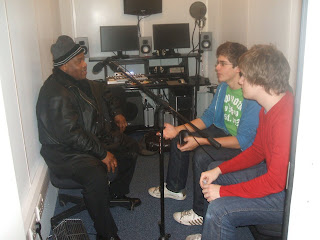
Here are some action shots of us producing our Documentary. These will be included with the rest of the paperwork when the project is finally submitted.


Documentary Project - Editing Diary

Posted by Ollie Tristram On 18:07 2 comments

Wednesday 26th November

We captured the footage to the computer and watched through it all. It came out as 4.5GB and 21 minutes in length, which according to Jules is about the right ratio for a 4 minute film. We didn't get time to do any work on it but Tom offered to cut up all the footage into individual clips at home, so it was easier to rearrange them for our editing.


Thursday 27th November

Today started with us imported all the separated clips, Tom had kindly spliced last night, into Adobe Premiere. It was very hand for him to have done that because it made life so much easier to just scroll through a list of clips and pick out the ones we wanted in a particular order.

Next, we simply began choosing clips, placing them in a provisional order and then began cutting them up - very straight-forward.

After doing so, and getting over 1 minutes worth of footage on the timeline, we began to take a look at the audio files we had recorded during the shooting. The live recording of the busker playing is fine, but we don't want to settle for second best, and we would be doing so if we kept our interview audio file. We have decided that there is too much hustle and bustle in the background, and not only does it make the interview more unclear, but there are sudden cuts between each section of speech. Anyway, we have booked out a sound booth and will be rerecording the interview on Monday.

Wednesday 3rd December

Today Jason was off ill with a cold so Tom and I continued with some of the editing ourselves.

We applied some visual effects to the footage in order to try and get that urban, gritty city look to our film. We did this by applying high contrast and lowering the saturation of the clips.

Also today, the other groups came to look at our edit. The general feedback was that it looked nice and the shots were well framed, but they thought because of our effects that the shot looked over-exposed.

Thursday 4th December

With Jason back in we showed him our new visual style and he liked it a lot. We didn't really do much else to the edit today because Debs came round to give constructive criticism. Generally I think she was quite impressed and the overall tips to take away from her feedback was to rearrange some of the clips as not to mislead the audience (for example, introducing the busker at the right time) and to go all or nothing with the effects so that nobody thinks its over-exposed and knows that we have applied effects.

Also, some filming tips I learnt was that one performing a pan, it counts as 3 shots: still, move, still. This way any still clips that come after it fit nicely. The other tip was to make sure in the future to always use manual controls - exposure in particular. We remembered white balance and manual focus but a couple of the shots that go from light to dark see the auto exposure kick in and the white colour fades in and out making it look more unprofessional.

Our main aim for today was to rerecord the interview with Sam and we booked out a sound booth and Edirol R-09 to redo this today. At 16.30 Sam turned up and we began interviewing. Compared the interview on the street we got a lot more audio, 17 minutes worth in fact, and we got everything we wanted out of him except him talking about other buskers, which was one of the main things we wanted for the voice over of our film!

When I got home that night I spliced up the interview into bite size segments with only the best and most clear parts of the interview. This cut down the 17 minutes into around 6 minutes of roughly 25 clips. This way the edit the next day will be easier to pick and choose each audio file we want.

Friday 5th December

Today our aim was to rearrange some of the clips, but most importantly to put the new audio on the film.

It started off kind of slow, picking the most related audio clips to go with their video counterparts, but once that was sorted we trawled through the rest of the interview/voice-over clips, picked out the best and placed them in the gaps where they fitted best.

When we were happy with the order the main thing to do now was to sort out the levels for the three audio tracks: the live recording, interview and city ambiance. One technique which was important for us to do was the use of ducking the live recording whenever Sam spoke during the voice-over, to make him clearly and more prominent in the audio mix. I spent a good hour or so going through the timeline and fluctuating the audio levels via use of automation at the appropriate parts.

FINISHED! Well not quite. But we were for the day. All that is left is for Tom to put the text on screen when the busker says the important stand-out lines.

Monday 8th December

Today we heard some more feedback from Jools and we learnt of a couple of tweaks we needed to make to our film. The first thing was to rearrange some more clips, most notably the second shot was too dark following the first, bright shot. This was deleted completely. We even added in a new shot we forgot we had of Sam waving at a passer-by. It works because it shows Sam's pleasant attitude and the effect he has on the people.

Another main issue was hearing the sound of some speakers other than headphones. The mixing was fairly bad because there were times when Sam's interview could not be heard over the backing track. We had to get this sorted and we did so by altering the ducking of the backing track more severely.

A third thing to change was to add more text from what Sam says during the voice-over. This keeps in the style more and also helps the audience follow the narrative easier.

Documentary Project - Shooting Diary

Posted by Ollie Tristram On 18:45 0 comments

Tuesday 18th November

Picked up the camera at Waverley building at 11am. The sun was shining and the air was clear - a perfect day for filming.

Our aim for the day was to film creative and artistic shots around the city to represent an image of where Sam, the busker, plays his music. This would include shots of the architecture, the grimey parts, and also all the people that live in the city.

We started off by walking to John Lewis to buy a Mini DV tape because we forgot to provide our own (oops) and then set out onto the streets of Nottingham. As we walked around we got a shot of the Cornerhouse, down alley-ways and down Clumber Street to show all the people walking the busy street.

We experimented with the manual focus and the zoom throughout the day to really try and show-off Nottingham in a fresh and unique way.

Along our travels we came across a couple of other buskers: a violinist and saxophonist. Although not planned, we thought getting shots of these two other buskers would work well in the documentary as they will also show the audience that Nottingham and it's society has some personality to it and of course, mainly that it would run along the same theme of busking.

As the day came to a close and the sun began to set we had gathered a variety of interesting shots which I am personally proud of and looked forward to Thursday to gather more city shots and interview and film Sam.


Thursday 20th November

After Tuesdays rather successful day shooting we were all looking forward to today, especially because we would be filming our main section.

On our way down to where Sam usually plays (outside River Island) we took some more stock footage of the surroundings of Nottingham, keeping in mind all the rules of taking a well framed shot, such as rule of thirds.

As we got down to Sam we said hello and told him our plans for the day that involved him. These were to get some angles of him playing, do an interview using an Edirol R-09, and do an audio recording of him playing live.

Over the next hour or so we got as many interesting shots as we could, focusing on his face, hands and wide shots. We also filmed creative shots like of the money he'd earned on his guitar case and of his amp. All which we plan to use in a montage effect.

After we began conducting the interview. I asked him questions on his busking, on Nottingham and on the people. With the recording the plan was to cut out all the sections where I am asking questions and use only the bits of Sam talking as if to get him telling a story. The only problem with this approach is that doing it in the street leaves you with sudden cuts as the background noise drops out. We will see how it sounds in the edit otherwise we will have to go and record some more city ambience to fill in the gaps.

Finally, after buying Sam a cup of coffee and giving him some change for his time, I set about getting a live recording of him playing and did so by laying the mic close to his amp as to reduce background noise to a minimal and only pic up his playing.

With footage and audio in hand, it's off to the editing!